Turning the building blocks of low-emission rice into real impact for farmers
A SAWiE webinar | London Climate Action Week 2026
Dr Wyn Ellis, former Executive Director of the Sustainable Rice Platform, formally opened the Rice Webinar, setting the context within London Climate Action Week and highlighting the importance of climate-smart rice systems for water security, soil health, and emissions reduction.
Rice feeds more than half the world and is grown on over 160 million hectares, yet flooded paddy cultivation generates roughly 8 to 12 percent of global methane emissions. As climate shocks, water scarcity and soil degradation intensify, the case for transforming how and where we grow rice has never been stronger.
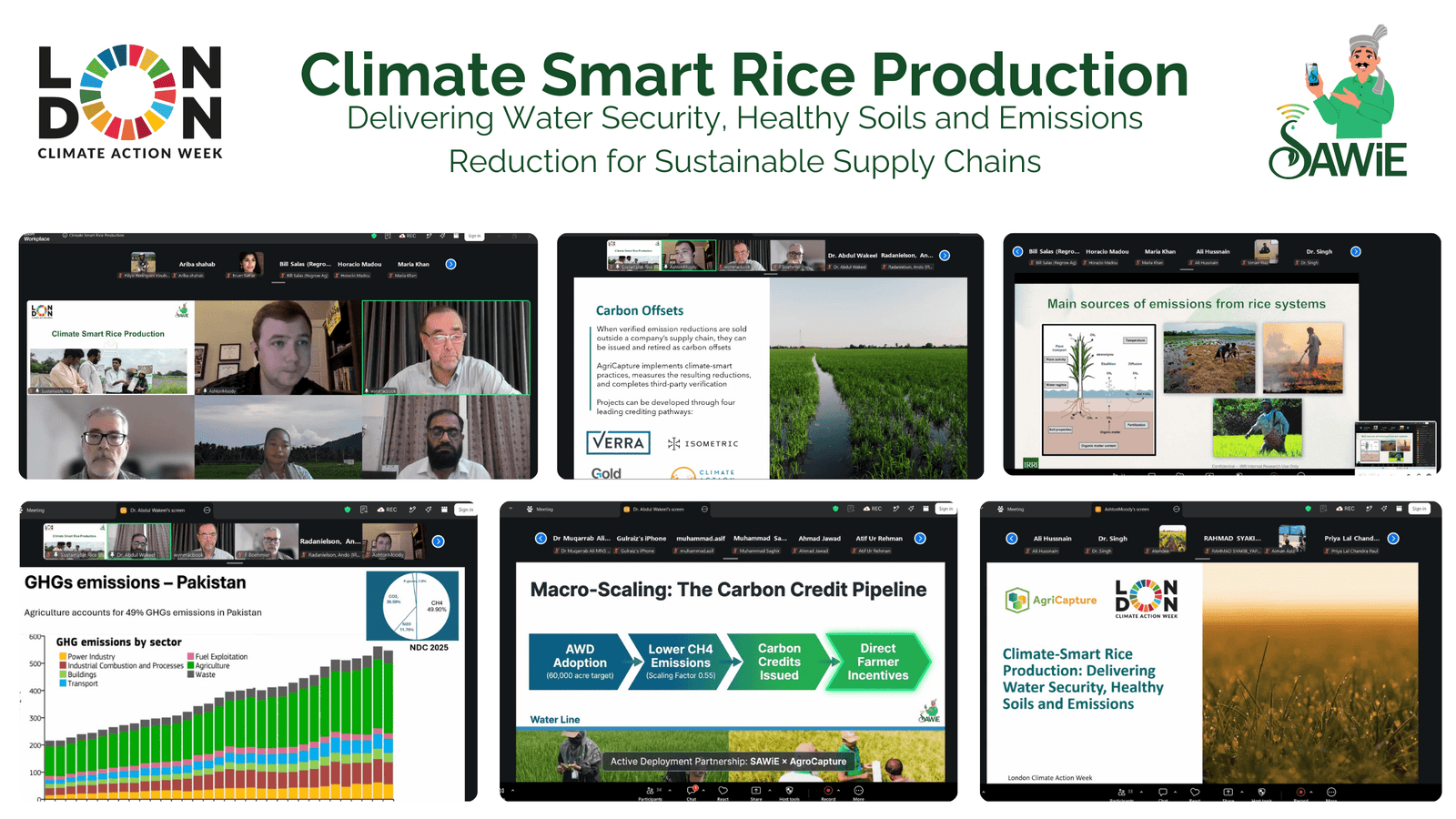
During London Climate Action Week 2026, SAWiE hosted a webinar bringing together four voices from across the rice value chain: research science, soil health, digital advisory, and carbon markets. The aim was simple. Show that the building blocks of climate-smart rice already exist, illustrate how they connect from farm to finance, and point to where the next step can be taken.
The demand side is moving fast. Food companies and retailers face growing pressure to cut supply chain (Scope 3) emissions. One recent marker: Lidl became the first major retailer to bring SRP-verified basmati rice to UK shelves.
The speakers
The science of low-emission rice
Dr. Ando Radanielson (IRRI) set the technical foundation, framing both the scale of the challenge and the readiest solution.
- A heavy footprint, a large opportunity. Rice occupies about 10 percent of global cropland but uses 15 percent of the world’s fertilizer and 35 percent of its irrigation water, and accounts for around 48 percent of agricultural methane emissions. It also holds the sector’s single largest mitigation opportunity.
- Where the emissions come from. Methane makes up 80 to 90 percent of rice emissions, driven mainly by continuous flooding that starves the soil of oxygen. Straw management is the second driver, and fertilizer use is the main source of nitrous oxide.
- A working definition. Low-emission rice combines carbon avoidance (cutting methane and nitrous oxide) with carbon removal (higher productivity and soil organic carbon). To scale, it must stay farmer-centric, protecting yield, income, cost efficiency and soil health.
- Alternate Wet and Drying (AWD) method is the proven front-runner. Alternate Wetting and Drying, refined since the 1990s, cuts water usage by 15 to 30 percent and methane by 30 to 70 percent. Safe AWD keeps the water table no lower than minus 15 centimetres to protect yield.
- Suitability varies by season. AWD suits roughly 90 percent of rice area in the dry season but only around 30 percent in the wet season (Philippines estimate), so an integrated approach matters: straw management, short-duration and low-emitting varieties, and direct-seeded rice.
- The gap is implementation, not technology. Incentives remain fragmented and extension is thin. AI modelling and remote sensing are emerging as routes to lower-cost, transparent carbon accounting, from Scope 1 through to Scope 3.
Healthy soils and field evidence from Pakistan
Professor Abdul Wakeel (University of Agriculture Faisalabad) grounded the science in field trials.
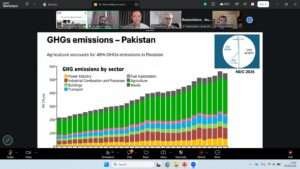
- Agriculture is the lever in Pakistan. Agriculture accounts for roughly half of national greenhouse gas emissions, with paddy rice contributing about 10 percent. That makes farm-level action central to the country’s climate response.
- Two sites, one clear signal. Trials supported by the Asian Development Bank, with technical input from IRRI, compared continuous flooding against AWD at Okara and Sheikhupura.
- Net emissions fall. Although AWD slightly raises nitrous oxide, total emissions in CO2 equivalent dropped sharply where AWD could be applied well (Okara). Where rainfall limited adoption (Sheikhupura), the effect was smaller.
- Better efficiency and yield. AWD used less irrigation water and produced a lower carbon footprint per kilogram of rice. Yields rose, helped by stronger root systems and less lodging than under continuous flooding.
- A win for yield, climate and water. The headline: higher yield, methane reduction of up to 70 percent, and water savings of around 21 percent. SAWiE has secured a project to channel carbon credits to farmers, with plans to expand to roughly 60,000 acres.
- Data must mature. For durable carbon claims, measurement needs to move from Tier 1 toward Tier 2 and eventually Tier 3 modelling across Pakistan.
Reaching the smallholder
Fritz Bohmler (SAWiE) turned to the hardest part of the chain: the millions of small farms where impact has to be earned, one field at a time.
- Small farms, big friction. Smallholders, often farming under five acres, are harder and costlier to reach. Unlevelled fields need more AWD tubes, and limited literacy and tight margins make farmers cautious about change.
- Data-driven only works with data. Input data on water and nitrogen is one half; yield and quality data, often missing, is the other. Without evidence of impact, farmers have little reason to switch.
- The persuasive language is income. If a practice clearly saves cost or lifts earnings, farmers engage. Framing AWD as water and input savings, rather than as emissions reduction, speaks to what matters at the farm gate.
- Traceability bridges the gap. SAWiE’s digital field book captures practice data from the start and builds full traceability from field to product. That record helps farmers reach buyers and, with partners such as AgriCapture, access carbon revenue.
- Better practice becomes an asset. When a farmer outperforms the local baseline on emissions, they create an environmental asset that can be sold inside or outside their supply chain. Net-zero targets are the main source of demand.
- Offset versus inset. A carbon offset sells the climate data separately from the grain, for example to a bank. A carbon inset keeps commodity and data together within the Scope 3 supply chain.
- Two ways to report Scope 3. Either a carbon intensity score attached to a volume of rice, or reported outcomes such as tonnes of emissions avoided. Companies with rice in their value chains increasingly treat it as a high-opportunity crop.
- Identity-preserved rice. Low-emission grain can be physically segregated and sold at a premium for traits such as lower water use, lower emissions, and in some cases reduced arsenic uptake.
- Credits through registries. Carbon offsets run through Verra, Gold Standard, Isometric and Climate Action Reserve. Because AWD avoids emissions rather than storing carbon, projects carry no permanence risk and can use shorter farmer agreements.
- A track record. AgriCapture’s US programme, running since 2021, has issued 175,000 credits and saved 51 billion gallons of water, with a BeZero A rating and an ICVCM core carbon principle label. Its SAWiE partnership covers the 2026 crop season, with credits expected in May 2027.
- Simplicity is the key to scale. The priority is a system simple enough for farmers to use themselves, since reliance on field teams limits scale. Carbon credits sit on top of this, as an added benefit rather than the core driver.
Connecting fields to markets
Ashton Moody (AgriCapture) closed the loop, showing how a practice in the field becomes a tradable, credible outcome.
- Better practice becomes an asset. When a farmer outperforms the local baseline on emissions, they create an environmental asset that can be sold inside or outside their supply chain. Net-zero targets are the main source of demand.
- Offset versus inset. A carbon offset sells the climate data separately from the grain, for example to a bank. A carbon inset keeps commodity and data together within the Scope 3 supply chain.
- Two ways to report Scope 3. Either a carbon intensity score attached to a volume of rice, or reported outcomes such as tonnes of emissions avoided. Companies with rice in their value chains increasingly treat it as a high-opportunity crop.
- Identity-preserved rice. Low-emission grain can be physically segregated and sold at a premium for traits such as lower water use, lower emissions, and in some cases reduced arsenic uptake.
- Credits through registries. Carbon offsets run through Verra, Gold Standard, Isometric and Climate Action Reserve. Because AWD avoids emissions rather than storing carbon, projects carry no permanence risk and can use shorter farmer agreements.
- A track record. AgriCapture’s US programme, running since 2021, has issued 175,000 credits and saved 51 billion gallons of water, with a BeZero A rating and an ICVCM core carbon principle label. Its SAWiE partnership covers the 2026 crop season, with credits expected in May 2027.
From the panel discussion
The discussion pushed past the presentations into the four questions that decide whether climate-smart rice scales: how to verify it affordably, how to claim it honestly, how fast it pays back in the soil, and whether the money actually reaches the farmer.

1. Cutting MRV costs with AI and remote sensing
Measurement, reporting and verification is the single biggest cost and credibility bottleneck in rice carbon, and the panel was optimistic but candid about today’s accuracy. The stakes are real: in 2024 almost all issued rice credits were invalidated, largely over additionality and verification concerns, which is why Verra’s tightened rice methodology (VM0051) matters. On cost, direct field sampling is the accuracy benchmark at roughly 15 to 30 US dollars per acre, modelling is cheaper but carries 20 to 40 percent uncertainty, and remote sensing is promising but still needs ground-truthing.
The weather limitation raised on the panel is specifically an optical-satellite problem. Optical imagery is blocked by cloud, which is common through the rice-growing wet season. Radar does not have that constraint: Sentinel-1 C-band SAR sees through cloud day and night, revisits roughly every six days at 10 metre resolution, and flood and dry-down maps built from radar thresholding reach accuracies above 70 percent.
2. Low-emission is not the same as sustainability
Treating the two as interchangeable risks overclaiming. Emissions are one axis among many. The Sustainable Rice Platform (SRP) Standard, the first global sustainability standard for rice, sets 41 on-farm requirements across eight themes: farm management, pre-planting, water use, nutrient management, pest management, harvest and post-harvest, health and safety, and labour rights. Greenhouse gas performance sits inside that wider frame, not above it, and the Standard pairs with 12 quantitative indicators so claims can be measured rather than asserted.
This is also a commercial point. High-integrity, CCP-labelled credits already command 15 to 25 percent price premiums, and buyers are moving toward verified claims, so a vague sustainable label is losing value while a specific, evidenced one gains it.
3. How fast soils recover
Some soil benefits are fast and some are slow, and conflating them sets the wrong expectation. Continuous flooding and puddling create a compacted plough pan that restricts roots and drainage and depresses the next crop, a well-documented drag on wheat yields in rice-wheat rotations and the exact pattern Professor Wakeel observed in the field. AWD avoids that damage, improving aeration and rooting with benefits often visible in the very next season. Soil organic carbon, by contrast, accumulates over several years and should not be promised on a one-season horizon.
What this could mean in practice:
• Separate the timelines in farmer messaging: quick wins this season (less compaction, better rooting, lower pumping and water cost) versus slower wins over several years (organic carbon, structure).
• Pair AWD with residue retention instead of burning, plus balanced nutrition, to speed organic-matter recovery rather than relying on water management alone.
• For sodic or degraded plots, combine with targeted amendments such as gypsum so soil-health gains are not bottlenecked by chemistry.
• Track a simple indicator set season over season (infiltration, penetration resistance, organic matter), which evidences the recovery story and feeds both SRP indicators and any premium claim.
4. Does the money reach the farmer
Whether carbon revenue changes behaviour comes down to net value after costs and risk. Real rice carbon payments are modest: roughly 15 to 25 dollars per tonne of CO2 equivalent. The structural risk is value capture, since across agricultural carbon intermediaries often take 40 to 60 percent of per-acre revenue, while leading farmer-first models return around 75 percent to growers. For a two-hectare smallholder, a payment of that size rarely outweighs adoption cost and yield risk on its own, which is why the panel framed credits as the icing on the cake rather than the meal.
What this could mean in practice:
• Stack revenue rather than rely on carbon alone: input and water-cost savings, a quality or low-emission grain premium, and the credit on top. AWD’s roughly 21 percent water saving and lower input use are immediate, cash-in-pocket gains.
• Use results-based or partial-advance payments to offset the wait and the risk, since credits in this kind of programme typically issue a year or more after the season.
• Reduce per-farmer cost through aggregation and shared MRV, so more of the price signal survives to reach the field, and pair every payment with training and demonstrated yield or quality gains.
The throughline
The session’s message was clear. The pieces of climate-smart rice already exist, from proven field practices and digital advisory tools to markets that can reward the farmers who lead. The work ahead is less about invention and more about connection: linking practice to data, data to markets, and revenue back to the farmer, while staying honest about MRV and who pays for it.
Get that right, and rice systems can be transformed for people, planet and prosperity.