News
🌾 Rethinking Rice: A Climate-Smart Pathway for Sustainable Rice Production in Pakistan
Rice is more than a crop in Pakistan.
It is food security, export revenue, rural employment, and cultural identity.Pakistan cultivates rice on approximately 3.9 million hectares (≈9.6 million acres), positioning the country among the world’s leading rice exporters. The sector supports millions of smallholder farmers and contributes significantly to national GDP.
Yet rice also sits at the centre of a growing climate dilemma.
The Methane Challenge
Conventional rice production relies on continuous flooding. While flooding suppresses weeds and supports crop growth, it creates anaerobic soil conditions the perfect environment for methane-producing microorganisms.
Methane (CH₄):
- Is 28 times more potent than CO₂over a 100-year period.
- Represents one of the largest agricultural greenhouse gas sources globally.
- Contributes significantly to Pakistan’s agricultural emissions profile.
With increasing pressure from climate commitments, export market sustainability standards, and water scarcity challenges, Pakistan’s rice sector must transition toward climate-smart production systems.
The question is not whether change is needed it is how to achieve it without compromising yields or farmer livelihoods.
Alternate Wetting and Drying (AWD): A Practical Climate Solution
Alternate Wetting and Drying (AWD) is one of the most promising solutions for methane mitigation in rice.
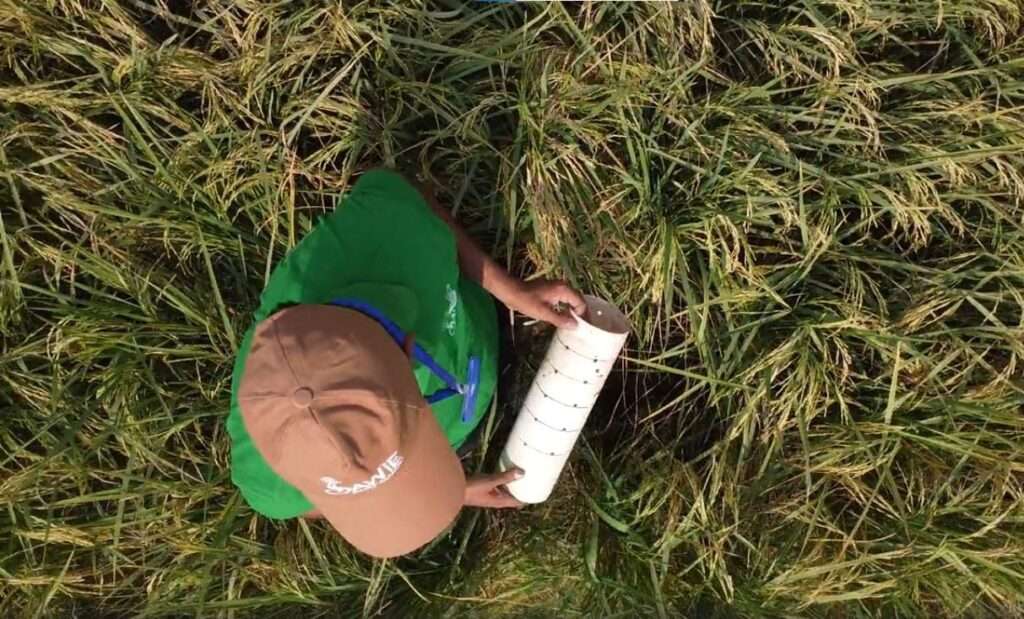
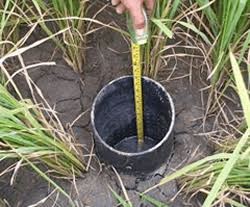
Instead of maintaining permanent flooding, AWD allows rice fields to dry intermittently before re-irrigation. Farmers monitor water depth using a simple perforated tube inserted into the soil profile.
Why AWD Works:
When soils periodically dry:
- Oxygen enters the soil.
- Methane-producing microbes are suppressed.
- Methane oxidation increases.
- Overall methane emissions decline significantly.
Documented Benefits (International Research Evidence):
- Upto 70% reduction in methane emissions
- Upto 40% water savings
- Maintained or improved yields when properly managed
In a water-stressed country like Pakistan, these water savings alone make AWD transformative.
🌱 Sustainable Rice Requires a Systems Approach
Methane reduction cannot happen in isolation. Sustainable rice production requires an integrated strategy:
1️⃣ Precision Land Preparation
Laser land levelling improves water distribution efficiency and prevents uneven flooding, reducing water waste and methane hotspots.
2️⃣ Balanced Nutrient Management
Optimizing nitrogen application:
- Improves nutrient-use efficiency.
- Reduces nitrous oxide risks.
- Lowers input costs.
3️⃣ Crop Residue Management
Instead of burning wheat residues, incorporating them:
- Enhances soil organic matter.
- Improves microbial health.
- Reduces air pollution.
However, residue incorporation must be paired with AWD to avoid methane spikes under continuous flooding.
4️⃣ Integrated Pest Management (IPM)
Reducing excessive pesticide use protects biodiversity and lowers environmental contamination while maintaining productivity.
🔬 Measuring Methane: A Robust Methodological Framework
For Pakistan to position itself as a leader in sustainable rice, credible measurement is essential.
A national methane reduction methodology could include:
Baseline Establishment
- Continuous flooding emission factors (IPCC-aligned).
- Historical irrigation and fertilizer practices.
- Yield benchmarks.
Intervention Tracking
- Irrigation event logging.
- Water level monitoring via AWD tubes.
- Remote sensing (NDVI, evapotranspiration).
- Field agronomic data collection.
Emission Calculation
- CH₄emission factors adjusted for water regime.
- Area-based emissions (kg CH₄/ha).
- Conversion to CO₂e using global warming potential factors.
- Net reduction validation.
Third-Party Verification
- Alignment with international carbon methodologies (e.g., Verra VM0042/VM0051 frameworks).
- Independent audit and data transparency.
This level of rigor is essential if Pakistan’s rice sector aims to access premium markets or carbon finance.
💰 The Economic Opportunity
Sustainable rice production is not just an environmental imperative, it is a commercial opportunity.
Global buyers increasingly demand:
- Low-carbon supply chains.
- Scope 3 emission reductions.
- Traceable and water-efficient production systems.
- Compliance with EU sustainability regulations.
If Pakistan can demonstrate:
- Verified methane reductions.
- Water stewardship.
- Soil health improvements.
- Transparent traceability systems.
It could command premium markets and position itself as a climate-aligned rice exporter.
👩🌾 Smallholders at the Centre
More than 80% of Pakistan’s farmers operate on small landholdings. Any sustainability transition must:
- Protect yields.
- Reduce input costs.
- Improve resilience to climate variability.
- Strengthen access to markets and finance.
AWD and regenerative practices offer:
- Lower irrigation costs.
- Reduced fertilizer expenditure.
- Improved soil structure.
- Greater climate resilience during erratic rainfall.
Sustainable rice must work for farmers first climate benefits follow when incentives align.
🌏 Water, Climate and Food Security Nexus
Pakistan is one of the most water-stressed countries in the world. Agriculture consumes nearly 90% of freshwater withdrawals.
Reducing irrigation demand by 30–40% in rice could:
- Preserve groundwater aquifers.
- Reduce energy use for pumping.
- Lower production costs.
- Improve long-term food security.
Methane mitigation through AWD therefore supports:
- Climate targets.
- Water security.
- Economic resilience.
- Rural stability.
🚀 A National Vision for Sustainable Rice
Pakistan has the opportunity to lead:
✔ Climate-smart irrigation (AWD at scale)
✔ Regenerative soil management
✔ Digital monitoring and traceability
✔ Carbon credit integration
✔ Premium sustainable export branding
The future of rice in Pakistan is not about reducing production.
It is about producing better with less water, lower emissions, healthier soils, and stronger farmer incomes.
Sustainable rice production is not an environmental luxury.
It is a strategic necessity for Pakistan’s climate resilience, export competitiveness, and rural prosperity.
And the transition can begin one field, one irrigation cycle, one farmer at a time.